Jerusalem, Jerusalem…
By Tessa Bielecki
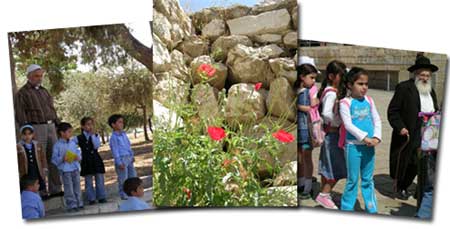
“How often I wanted to gather your
children together…” (Matthew
23:37)
This is my last morning in Jerusalem. For the first time in my two-week sojourn, I slept through the cries of the muzzeins, beginning at 3:40 am, amplified by multiple microphones. I awake instead to the cooing of the doves outside my window, under the pomegranate tree in the garden of the Lutheran Guesthouse.
I dress quickly, not wanting to miss a minute, and go up to the rooftop to greet the day and salute the holy city. Jerusalem is usually noisey, but dawn has not yet come, and most of the city still sleeps. It is quiet except for the gentle sounds of nature. Swallows twitter and fly between the rooftops. The doves continue cooing. The calls of the ravens are soft and not as raucous as they are in Colorado.
Wind blows through the trees in the garden and rustles the leaves of the purple-blossomed jacaranda, the palms, the locust and the loquat, the tiny olive and the majestic fig. I marvel at the bright colors of the hollyhocks, nasturtiums, and oleanders. I can smell lavendar and the red geraniums.
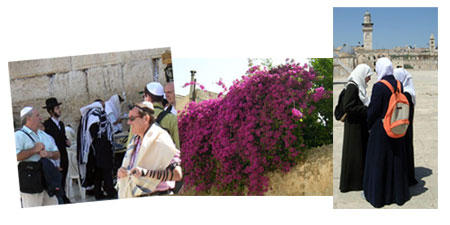
A rooster crows as I thank God for another day, for this remarkable journey, and for the roof tops, one of the wonders of life in the Middle East, along with hummous, tomatoes and cucumbers for breakfast! Next door a young Palestinian is already talking on his cell phone. Across the way a Greek Orthodox priest hangs his freshly washed black robe out to dry. Below me a pious Jew, wrapped in his prayer shawl, takes a shortcut over the roofs to his morning prayers at the “Wailing” Wall.
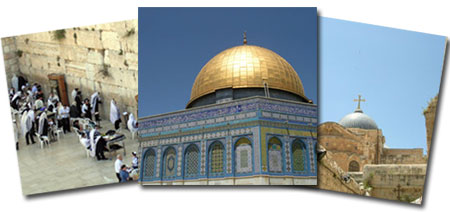
The Western Wall, Dome of the Rock, and
Church of the Holy Sepulcher
The homier rooftops feature lush flower pots and oriental rugs. Lavish deep pink bougainvillia spills over the wall to the south. Someone on the west side has even planted a grape arbor. Caper bushes stubbornly push out of numerous nooks and crannies in the stone. I discover, to my utter delight, that the capers we eat, usually in fish dishes, though the plant comes from the desert, is not a berry after all but an unopened bud. The caper flower is delicate and exquisite. I photographed one in the rocks at Masada and another at Tabga, where we believe Jesus cooked fish on the beach for his disciples after he rose from the dead. Tabga is one of the quieter holy sites, and therefore one of my favorites.
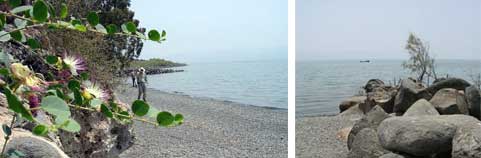
Caper bush on the beach at Tabga on the
Sea of Galilee
The old city of Jerusalem is “one square mile of religion.” (Someone once said it “stinks of religion,” and on some days I feel rather than smell the truth of that.) I look out at lovely minarets, crowned with their evocative stars and crescents, at the black domes of the Church of the Holy Sepulcher, and the tall bell tower of the Lutheran Church of the Redeemer. I climbed the tower yesterday, all the way up the winding staircase, suffering stifling claustrophobia in the narrow passageway. But what a spectacular view in all four directions at the top, above the massive bells, which rang while I was there and almost deafened me!
At this hour the utilitarian solar panels, water tanks, satellite dishes, and TV antennas steal nothing of the magic of the ancient white stones of the old city, streets as well as roofs and walls. I am sobered by the number of Israeli flags and the barbed wire around Jewish “settlements”, incursions into the Christian and Arab quarters of the city. Outside the walls of the old city lie the unappealing concrete, glass, and steel high rises of modern West Jerusalem. Marring the skyline of this “secular” state, unsightly cranes indicate extensive new construction. For the first time I notice the umbrellas and tables on the roof of Papa Andrea’s restaurant and decide that I must eat lunch there today.
At 6 am the Christian church bells begin to ring out the angelus, more synchronized than the cacophanous calls of the muzzeins. Soon afterwards, the sun rises beyond the pines and eucalyptus on the Mt. of Olives. It is a bright and blinding orb in today’s hazy sky, illuminating the Hebrew University on Mt. Scopus, the tower of Augusta Victoria Hospital, the onion domes of St. Mary Magdalene’s, the stark and treeless Jewish cemetary on the Mt. of Olives, and closer to me, the golden Dome of the Rock.
I can just barely see my favorite church in the Holy Land, Dominus Flavit (“the Lord wept”), the site where Jesus wept over Jerusalem as we read in the Gospel of Matthew (23:37): “Jerusalem, Jerusalem, you that kill the prophets and stone those who are sent to you!” Jesus must weep even more today over Jerusalem and all of Israel-Palestine, as I weep this morning as well.
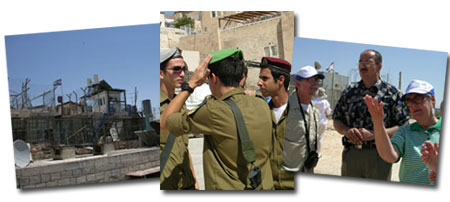
Signs of a militarized Jerusalem
On my last day here, this is the first day I don’t have to go early to the bus for heavily scheduled visits with Palestinians suffering under the occupation of the West Bank and brave Israeli human rights groups struggling to relieve that suffering and build a better Israeli society.
One such group, New Profile: Movement for the Civilization of Israeli Society, opposes the Occupation on three counts: 1) its destruction of Palestinian life, society, land, and property, 2) its role in maintaining militarism in Israel, 3) its erosion of Israeli socio-economic and moral fabric. New Profile, along with other Israeli peace groups, seeks “non-violent means of ending this catastrophic Occupation” by “using economic sanctions to pressure the government to change its policy.” In one official statement, the group contends that “ending the occupation is not only to the benefit of the Palestinians but also necessary for the welfare of Israel, its youth, and future generations. Over 20,000 Israeli soldiers have died in wars since 1948. Enough. It is time to beat our swords into ploughshares, to bring security to Israel by giving the Palestinians their freedom and recognizing their absolute right to exist, and to build a future for today’s Israeli youth and generations to come by creating a civilian society whose underpinnings are equality of gender and ethnicity and universal human rights.”
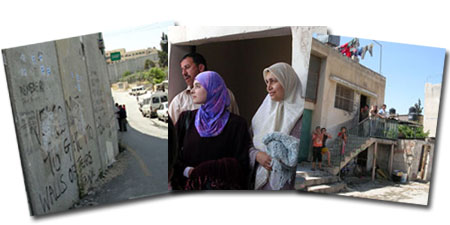
“Destruction of Palestinian life”
and “erosion of Israeli…moral
fabric”
This is by far the best of my three trips to the Holy Land. On the first two visits in 1989 and 2000, the undercurrents of unrest and injustice went unaddressed, yet palpably infected the pilgrimages. This time we addressed the painful conflicts head-on, and that made all the difference. Until this “fact-finding” trip, I had no idea so many Israelis are opposed to the Occupation and work on behalf of Palestinian human rights, for the sake of Israel as well.
We met with Rabbis for Human Rights, with “refuseniks”, veteran Israeli soldiers who refuse to serve in the West Bank and help younger soldiers recognize their right to make the same protest for the sake of a truer national security, and with Machsom Watch, a group of Israeli women who monitor some of the hundreds of military checkpoints to assist Palestinians who may be harrassed not only by soldiers but by Israeli “settlers.” (Many babies have been born at the checkpoints, and several people have died because they were not allowed to pass through for urgent medical care.)
We also visited a refugee camp, hospitals and schools, B’Tselem, the Israeli Center for Human Rights in the Occupied Territories, and the Christian Peacemakers Team in Hebron which escorts Palestinian children to school to protect them from hostilities.
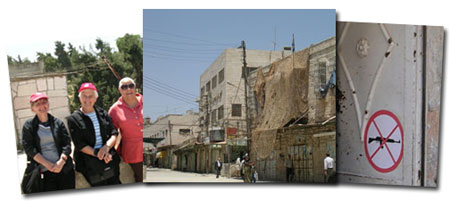
Christian Peacemakers in Hebron
On Friday we stood as witnesses with the Israeli Women in Black, who hold signs with only one simple message in Hebrew, Arabic, and English: End the Occupation, mourning for all the victims on both sides, and suffering tremendous verbal abuse from passing cars and pedestrians on the busy street corner.
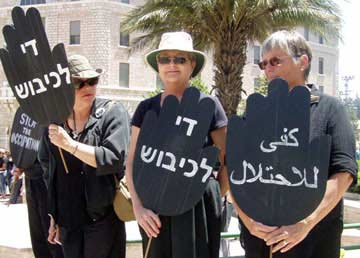
Standing with the Women in Black: Iris
Keltz from Albuquerque, New Mexico, Joan
Fairweather from Ottawa, Canada, and Tessa
Bielecki from Crestone, Colorado
The most moving encounter was with the Bereaved Families Network, a group of Israelis and Palestinians who have lost loved ones in the recurring violence. Grief helps them move beyond their differences and bond as brothers and sisters, true children of a common father, Abraham, in a common land they share. Israeli-Palestinian pairs travel throughout Israel and the world to be living witnesses to the reality of peace.
Part of the problem is that many Israelis and Palestinians live in complete isolation from one another and never meet. As one Palestinian girl said: “I never thought in my whole life that I would meet ‘the other side’ or talk to them… I cannot describe how thankful I am.” Her Israeli counterpart agreed: “Can you imagine what it is like for me, a Jewish Israeli teenage girl, that had never met a Palestinian before, and who only lives a few miles away from them… A magical wave of hope filled my whole body and I hope this feeling never leaves me.”
We also took time to visit various holy sites: Church of the Nativity in Bethlehem, Mount of the Beatitudes and the Sea of Galilee, the Tomb of the Patriarchs and Matriarchs, Church of the Annunciation in Nazareth, the Via Dolorosa and Holy Sepulcher in Jerusalem, Jericho, Qumran, Masada, the Dead Sea and Mt. of the Temptations in the glorious Judean Desert. But these are stories for another time.
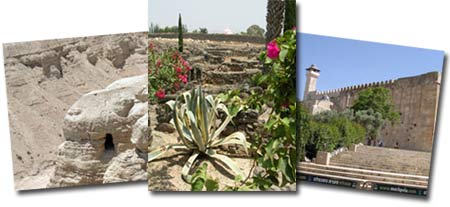
Qumran cave, Capernaum, and the Tomb of
Abraham and Sarah
Everywhere we went we ran into the illegal “Wall” that is suffocating Palestinian life and “shaming” Israel, as some say. In what some Israelis call a “colonial land grab,” the Wall takes land from the Palestinian side, requires the bulldozing of thousands of ancient olive trees, essential for the Palestinians’ livelihood, deprives people of their own water, which they then must buy back from Israel, and keeps them locked inside, cut off from health care, schools, markets, and even their own families and fields. Some villages are completely surrounded by the wall where a single nineteen-year-old armed soldier has the power to close the gate and lock in 40,000 people. One Palestinian leader told us it’s easier for him to go to Europe than past the wall into Israel.
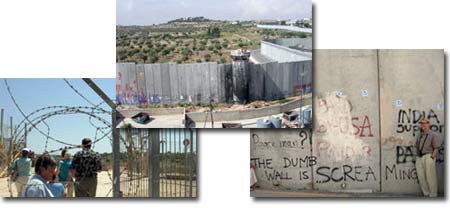
“The Dumb Wall is Screaming”—through
the razor wire.
In July of 2004, the International Court of Justice ruled that the building of the Wall violates International Law and called on the international community to refrain from any assistance that promotes this violation in any way. According to the ruling, “construction of the wall within the Occupied Territories severely impedes the Palestinian people’s right to self-determination and is therefore a breach of Israel’s obligation to respect that right.” The Court announced that all states are therefore obliged:
- not to recognize the illegal situation resulting from the Wall and not to render aid or assistance in maintaining the situation created by such construction (passed by a vote of 13 to 2).
- to insure compliance by Israel with international humanitarian law as embodied in the [Geneva] Convention (passed by a vote of 13 to 2).
- to bring to an end the illegal situation resulting from the construction of the Wall and the associated regime, taking due account of the present Advisory Opinion (passed by a vote of 14 to 1).
Grafitti on both sides of the Wall tells the true story: “Shame on you Israel.” “Thou shalt not steal.” “From the Warsaw Ghetto to the Abu-Dis [name of a Palestinian village] Ghetto.” “Stop the racist wall.” “Paid for by the USA.” Entry into Bethlehem through the Wall ironically proclaims “Peace be with you” from the Israeli side, a “peace” maintained with guard towers, razor wire, and soldiers with machine guns.
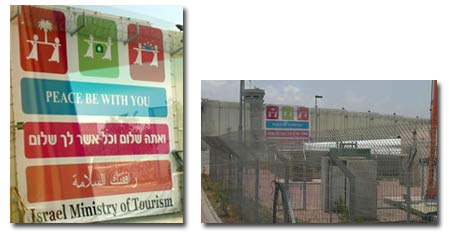
Entrance to Bethlehem, City of “Peace”
I was inspired by the heroism of all the Israeli peacemakers who work so hard to wake up their fellow citizens and influence the government to correct its injustices and create a truly viable society. Many feel that the present situation is unsustainable, largely because it erodes the very soul of Israel.
I was also inspired by the heroism of the Palestinian peacemakers who work so hard to maintain their dignity in the face of such grave injustice. The motto of one school reads: “Destruction may be… Creativity will be.” T-shirts at one of the refugee camps proclaim the indomitable spirit of the people: “to dream together, to work together, to decide together, to build a future together.” As the administrator of one health care center beseeched us, “Please see us as normal human beings, not as traumatized Palestinians under occupation. We are learning coping techniques to ‘normalize’ our lives and consider them ‘good.’” In the spirit of John 10:10, the people of Bethlehem especially believe that they “deserve life and life abundantly.” “We nurture hope,” said one teacher. “If we lose our hope, we lose our humanity.”
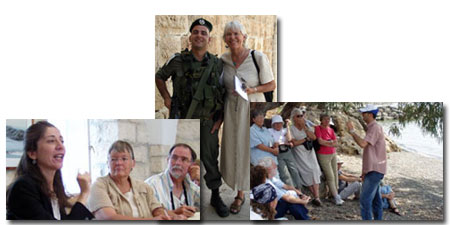
“If we lose our hope, we lose our
humanity.”
I feel profoundly changed by this journey and sense a new calling to do my part to help the Holy Land by helping to remove “walls” and build bridges. As a Palestinian Christian woman at the Sabeel Ecumenical Liberation Theology Center said, “We cannot be true to serving God without politics.” According to American Rabbi Michael Lerner, “Politics is a manifestation of the spiritual and ethical consciousness of humanity.” Having focused on spirituality for more than half my life, I feel ready now to manifest the important political dimension of that spirituality, which Fr. Dave describes as “political love.” As we pray in Psalm 137, “If I forget you, O Jerusalem, may my right hand wither.”