
The Universal Desert
an interview with
Fr. Dave Denny
Q: Why focus on the world’s deserts?
A: In a world of mobility and displacement, many long to recover the importance of the sense of place in general. A common Arabic greeting is Ahlan wa sahlan, which roughly translates to, "This is your land, and these are your people." The Desert Foundation gathers together friends who study, publish, and share their wisdom about the desert: the land, the people and the spirituality.
Q: What if I don't live in the desert?
A:The desert is not only geography, but spirit. Some desert places, the American Southwest and the Middle East, for example, are considered sacred and have become “a battleground of conflicting claims based on a multitude of cultural voices,” as Belden Lane wrote in Landscapes of the Sacred. We hope to shed light on such claims and highlight peaceful solutions to these geo-spiritual conflicts.
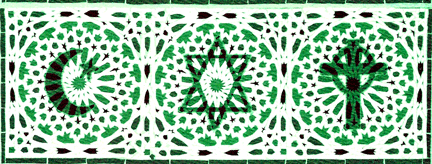
Q: At this sorrowful moment in history when the sons and daughters of Abraham are shedding each other's blood throughout the world, you emphasize peace between Jews, Christians, and Muslims?
A: Yes. Peacemaking happens best when we develop a way of life that includes an understanding of desert spirituality. That is, the desert, in addition to being geography and spirit, has traditionally fostered a certain kind of spirit: hospitality, respect, and dialogue with the stranger. This spirituality arises from various kinds of exposure to the “desert”: a freely chosen dedication to humility, interfaith dialogue, and simple, ecologically sustainable living.
Q: What about the "inner desert"?
A: The inner desert arises primarily from grief, which is a universal human experience: the desert of unchosen loss, of death, of exposure to pain that grinds the soul to dust and bears within it the threat of despair as well as the hope of transformation, compassion, and a life dedicated to justice and mercy.
Q: Many of us think of the desert as a wasteland.
A: For many people, the desert is a place to be avoided. It is a place of banishment or grief, or simply useless and vacant. In English, when we say that a place is “deserted,” we usually mean that nothing significant may be found there. But Abraham, Jesus, Muhammad, and countless saints from each of the Abrahamic traditions discovered the desert as a harsh school of human and moral maturation. The Arabic word ashara means to enter the desert, for there, according to David Jaspers' The Sacred Desert, "if one knows where to look, there are springs and wells of water and places of life.” That's why we've chosen the passage from Isaiah 35:1 to describe the heart of the Desert Foundation: The desert and the dry land will be glad; the wilderness will rejoice and blossom.